


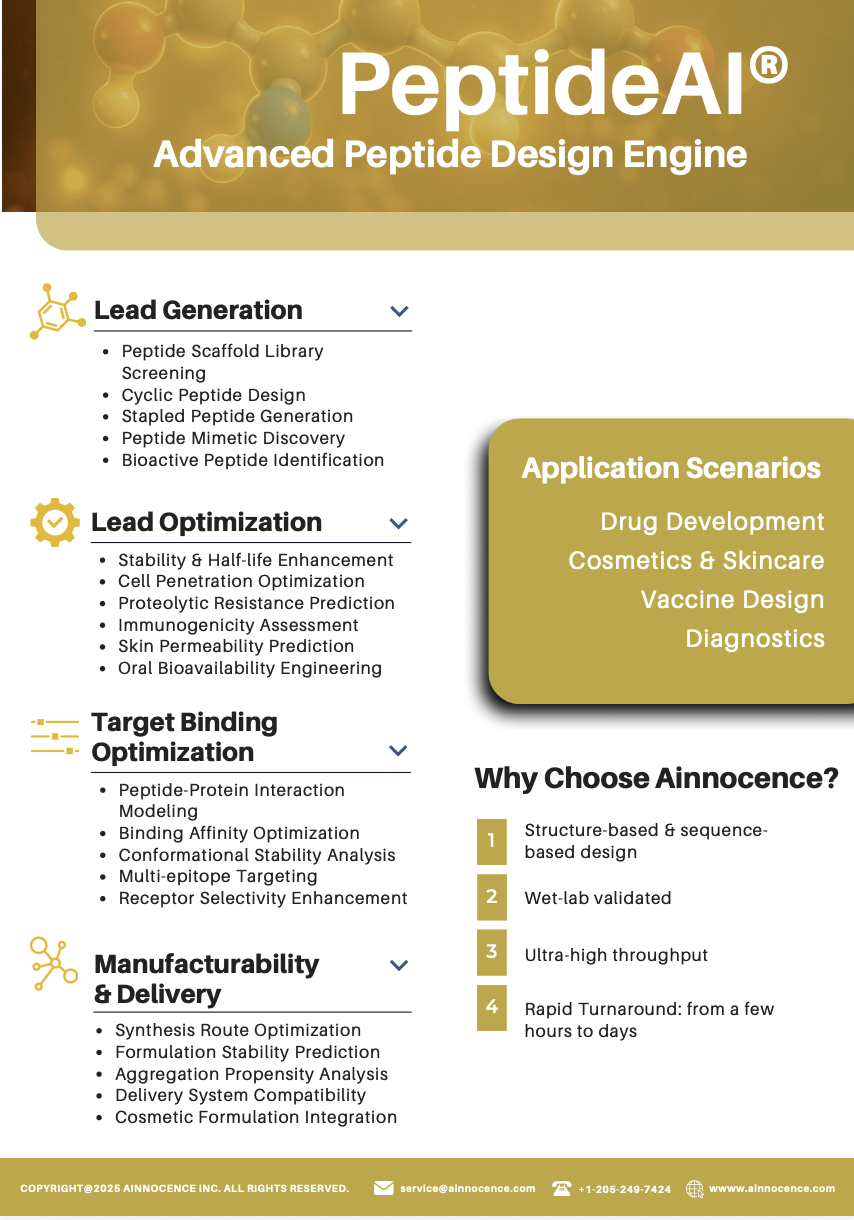
PeptideAI® designs next-generation peptide therapeutics with enhanced stability, selectivity, and bioavailability
Foundation model-powered dual-module system establishes a new performance benchmark for AI-driven peptide drug discovery
SAN FRANCISCO , CA, UNITED STATES, April 15, 2026 /EINPresswire.com/ — Ainnocence, Inc. a next-generation AI drug discovery company, today announced validated performance benchmarks for the Ainnocence Peptide AI Platform, a dual-module system built on the Ainnocence’s proprietary protein foundation model for peptide drug discovery. Module I, the platform’s peptide activity classifier, achieved 90.2% accuracy and a 93.2% ROC-AUC (the area under the receiver operating characteristic curve, a standard measure of how reliably a model separates active from inactive candidates) on a curated benchmark of 28,535 peptides. Module II, the platform’s multi-property predictor, simultaneously forecasts 13 therapeutic properties with a 77.8% micro F1 score, a metric that balances precision and recall across all property labels.
From Millions of Candidates to a Focused Shortlist
Peptide therapeutics occupy a chemical space too large to traverse experimentally: a single 20-residue scaffold yields more than 100 quadrillion possible sequences, a number that dwarfs the estimated count of stars in the observable universe. The Ainnocence platform addresses this bottleneck by computationally screening millions of variants and returning a high-confidence shortlist for wet-lab validation. In production runs, the system has evaluated more than 3.2 million peptide variants, compressing what would otherwise be years of assay work into a matter of hours and allowing discovery teams to direct experimental resources toward sequences with the strongest predicted profiles.
The Ainnocence Protein Foundation Model: A Shared AI Backbone
Both modules are powered by the Ainnocence proprietary protein foundation model, a deep learning system trained to encode the biochemical and structural properties of amino acid sequences into rich, high-dimensional numerical representations. These learned embeddings capture residue-level context, including physicochemical properties, sequence motifs, and positional dependencies, and serve as the universal feature basis for all downstream prediction tasks.
This shared foundation model architecture is what gives the platform its dual advantage: a single, deeply learned representation of protein sequence space powers both high-throughput activity classification and multi-property therapeutic profiling, ensuring consistency and knowledge transfer across the entire pipeline.
Module I – Ensemble Activity Classifier: The foundation model embeddings feed into a proprietary ensemble of independently trained classifiers, each operating on stratified data partitions. Predictions are aggregated through soft-vote consensus, yielding both a final activity class and a per-model confidence breakdown that enables uncertainty quantification, a critical capability for triaging candidates into wet-lab pipelines.
Module II – Bidirectional Deep Sequence Encoder: The same foundation model embeddings are routed through a bidirectional recurrent deep neural network that processes sequences in both forward and reverse directions, capturing long-range amino acid dependencies and producing a unified sequence-level representation. Thirteen parallel prediction heads share this encoder backbone, enabling multi-task transfer learning: signal from data-rich therapeutic endpoints (e.g., antimicrobial, anticancer) strengthens predictions on data-sparse ones (e.g., antiparasitic, immunomodulant). The result is a comprehensive 13-property therapeutic profile from a single inference call.
Benchmark Performance
The dual-module model demonstrated stable cross-validation behavior across folds, with a mean prediction confidence of 0.9765 across the 3.2 million screened variants, an indicator that the model is well calibrated rather than producing overconfident outputs near the decision boundary. It leverages multi-task transfer learning, in which a shared representation is trained jointly across related therapeutic endpoints so that signal from data-rich properties improves prediction on data-sparse ones. This shared backbone is what enables simultaneous prediction across all 13 properties at 77.8% micro F1, a level of breadth that single-task models typically cannot match without substantial accuracy loss.
Application Value
The platform supports several discovery workflows of immediate interest to biopharma teams. In large-scale mutation screening, ranks every single- and multi-point variant of a parent peptide to surface activity-preserving or activity-enhancing substitutions, turning a 3.2-million-variant library into a focused shortlist in hours. In antimicrobial peptide optimization, the joint output of both modules guides sequences toward improved potency while simultaneously flagging properties such as hemolysis and toxicity across all 13 predicted endpoints. For drug repurposing, the model’s comprehensive activity profile allows known peptides to be re-evaluated against therapeutic categories beyond their original indication, identifying candidates worth advancing into new programs.
Deployment Readiness
The Ainnocence Peptide AI Platform is delivered through a serverless GPU inference backend exposed via a REST API, enabling seamless integration with existing computational pipelines and electronic lab notebooks. Module II returns predictions in under 50 milliseconds per query, and Module I supports batch screening at the multi-million-variant scale demonstrated in the benchmark study. The serverless architecture scales to zero when idel, eliminating infrastructure overhead for partner organizations.
Executive Commentary
“The numbers reflect what we set out to build: a peptide discovery engine that is both broad and precise enough to be trusted with real program decisions. By coupling our proprietary protein foundation model with high-accuracy activity prediction and multi-property deep learning profiling at scale, we are giving discovery teams a way to compress timelines without compromising scientific rigor.” – Dr.Lurong Pan, PhD, Founder and CEO of Ainnocence.
About Ainnocence
Ainnocence is a next-generation AI drug discovery company founded in 2021 and headquartered in Mountain View, California. The company’s platform encompasses generative AI platform to screen up to 10 billion molecules within hours to accelerate drug discovery, CarbonAI® for small-molecule and PROTAC design, SentinusAI® for antibody engineering, CellulaAITM for cell therapy, NatmolAITM for natural product discovery, and additional AI engines spanning target assessment and biosynthesis. Ainnocence partners with pharmaceutical and biotechnology organizations to compress discovery timelines and improve the quality of candidates advancing into development. For more information, visit ainnocence.com.
Lurong Pan, PhD
Ainnocence
205-249-7424
[email protected]
Visit us on social media:
LinkedIn
YouTube
Legal Disclaimer:
EIN Presswire provides this news content “as is” without warranty of any kind. We do not accept any responsibility or liability
for the accuracy, content, images, videos, licenses, completeness, legality, or reliability of the information contained in this
article. If you have any complaints or copyright issues related to this article, kindly contact the author above.

